30 days refund guarantee
Cladh Hallan :Roundhouses and the dead in the Hebridean Bronze Age and Iron Age, Part I: stratigraphy, spatial organisation and chronology
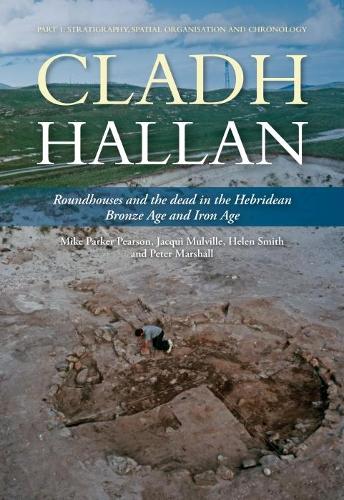
Cladh Hallan :Roundhouses and the dead in the Hebridean Bronze Age and Iron Age, Part I: stratigraphy, spatial organisation and chronology
hardback
Published:
15 August, 2021
hardback
Published:
15 August, 2021

FREE Delivery by
Thu, April 9 - Fri, April 10
Order within
0

Condition:
NEW
£31.55
RRP
£35.00
You save £3.45 (10%)
Available
1
in stock
FREE Returns within 30 days
Popular Books by Mike Parker Pearson
View All Books by Mike Parker Pearson
Description
This first of two volumes presents the archaeological evidence of a long sequence of settlement and funerary activity from the Beaker period (Early Bronze Age c. 2000 BC) to the Early Iron Age (c. 500 BC) at the unusually long-occupied site of Cladh Hallan on South Uist in the Western Isles of Scotland. Particular highlights of its sequence are a cremation burial ground and pyre site of the 18th–16th centuries BC and a row of three Late Bronze Age sunken-floored roundhouses constructed in the 10th century BC. Beneath these roundhouses, four inhumation graves contained skeletons, two of which were remains of composite collections of body parts with evidence for post-mortem soft tissue preservation prior to burial. They have proved to be the first evidence for mummification in Bronze Age Britain. Cladh Hallan's remarkable stratigraphic sequence, preserved in the machair sand of South Uist, includes a unique 500-year sequence of roundhouse life in Late Bronze Age and Iron Age Britain. One of the most important results of the excavation has come from intensive environmental and micro-debris sampling of house floors and outdoor areas to recover patterns of discard and to interpret the spatial use of 15 domestic interiors from the Late Bronze Age to the Early Iron Age. From Cladh Hallan’s roundhouse floors we gain intimate insights into how daily life was organized within the house - where people cooked, ate, worked and slept. Such evidence rarely survives from prehistoric houses in Britain or Europe, and the results make a profound contribution to long-running debates about the sunwise organisation of roundhouse activities. Activity at Cladh Hallan ended with the construction and abandonment of two unusual double-roundhouses in the Early Iron Age. One appears to have been a smokery and steam room, and the other was used for metalworking.
More Details
| Type | Book |
|---|---|
| ISBN13 | 9781789256932 |
| ISBN10 | 1789256933 |
| Number Of Pages | 568 |
| Item Weight | 1000 g |
| Publisher / Reseller | Oxbow Books |
| Format | hardback |
See More +
Media Reviews
The first of two promised monographs (the next will feature artefacts, animal bones and environmental and human remains), this rich compendium presents the site’s stunning stratigraphy – soils, structures, burials, dating and pottery. * British Archaeology *
A large publication, this book contains a vast amount of information, including chapters on thin-section soil micromorphology, scientific dating and pottery, that will be of interst and use to other researchers. * Archaeology Ireland *
It is not often that one opens the pages of a huge excavation report with a real sense of anticipation, awaiting the depth and detail that a monograph affords to shed light on a site that garnered much media attention … [It] finally allows the context, chronology, and interpretation of these discoveries to be explained in depth … [and] shows how flexible and evolving excavation methodologies and research questions can lead to outstanding results … There is no doubt that the understanding of later prehistoric lifeways, house building, cosmology, burial practices, metallurgical crafts, farming and ceramics have all been augmented by the work at Cladh Hallan and this wonderful volume. * Scottish Archaeological Journal *
Lucid writing and communication of the highly complex site stand out throughout the publication … Much more than a primer or scene-setter for the human remains, [this] is a great asset and a superb volume supported by high production values and lavish illustrations. The book evokes 500 years of settlement development and forms a contextualised basis for understanding the dynamic interplay between the dead and the living. [It] thus makes a highly important contribution to our understanding of Scottish and British later prehistory. * Antiquity *
It is one of those rare archaeological sites that transform the mundanity of everyday domestic life into something very much extraordinary, generating fascination from academic and lay audiences alike. So, it should come as no surprise that we feel [this volume] on the Bronze Age and Iron Age roundhouses at Cladh Hallan, which are presented in full alongside the buried human remains associated with them, should be very well received by archaeologists and all those interested in the later prehistoric archaeology of Britain … The monograph is also incredibly well illustrated with 575 figures, over 280 of which are in colour … While this volume will immediately appeal to people interested in later prehistoric settlement in Britain, anyone wanting to see a slightly different take on the printed archaeological monograph should also have a look between its covers. * Archaeological Journal *
Author's Bio
Mike Parker Pearson is Professor of British Later Prehistory at the Institute of Archaeology, University College London. A distinguished prehistorian, he has been involved with many major projects, including leading the recent Stonehenge Riverside Project. Jacqui Mulville is Professor of Archaeology at Cardiff University. A distinguished bioarchaeologist, she is a field archaeologist with 35 years of excavation experience whose research focuses on osteoarchaeology, human and animal identities, and island archaeologies concentrated on Britain. Helen Smith has been Senior Lecturer in Archaeology at Bournemouth University, specialising in the analysis of archaeobotanical remains, having completed her PhD in Archaeology at the University of Sheffield on traditional farming practices of the Western Isles. Pete Marshall is a leading specialist in radiocarbon dating and statistical modelling. He is director of Chronologies and works in Historic England’s Policy & Evidence Department as part of the Scientific Dating Team. He has been involved in many iconic archaeological projects over the last twenty years.