30 days refund guarantee
Contesting the Gothic :Fiction, Genre and Cultural Conflict, 1764–1832 - Cambridge Studies in Romanticism
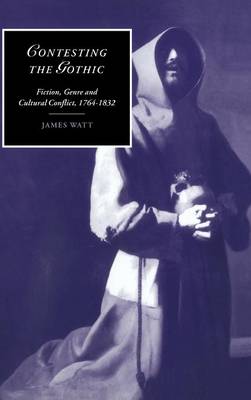
Contesting the Gothic :Fiction, Genre and Cultural Conflict, 1764–1832 - Cambridge Studies in Romanticism
hardback
Published:
28 June, 1999
hardback
Published:
28 June, 1999

FREE Delivery by
Tue, April 28 - Wed, April 29
Order within
0

Popular Books by James Watt
View All Books by James Watt



Description
James Watt's historically grounded account of Gothic fiction, first published in 1999, takes issue with received accounts of the genre as a stable and continuous tradition. Charting its vicissitudes from Walpole to Scott, Watt shows the Gothic to have been a heterogeneous body of fiction, characterized at times by antagonistic relations between various writers or works. Central to his argument about these works' writing and reception is a nuanced understanding of their political import: Walpole's attempt to forge an aristocratic identity, the loyalist affiliations of many neglected works of the 1790s, a reconsideration of the subversive reputation of The Monk, and the ways in which Radcliffean romance proved congenial to conservative critics. Watt concludes by looking ahead to the fluctuating critical status of Scott and the Gothic, and examines the process by which the Gothic came to be defined as a monolithic tradition, in a way that continues to exert a powerful hold.
More Details
| Type | Book |
|---|---|
| ISBN13 | 9780521640992 |
| ISBN10 | 0521640997 |
| Number Of Pages | 220 |
| Item Weight | 500 g |
| Product Dimensions | 152 x 229 x 16 mm |
| Publisher / Reseller | Cambridge University Press |
| Format | hardback |
See More +
Media Reviews
"James Watt argues that generic labels need to be re-examined, with greater attention given to the historical specificity of certain "so-called Gothic" works. This is an exciting historicist study that provides important contextual material for Gothic scholars." British and American Literatures
"...Contesting the Gothic is impressively researched, well-documented, and convincing in its claims." Jeffrey Andrew Weinstock, Journal of the Fantastic in the Arts
"The exposition is lucid, the reasoning scrupulous, the tone measured and never polemical. The book can be recommended to anyone as the model of a focused and thoroughly professional investigation that carves out a niche of originality in a very crowded literary shelf." Eighteenth-Century Studies