30 days refund guarantee
The Boundless Deep :Young Tennyson, Science and the Crisis of Belief
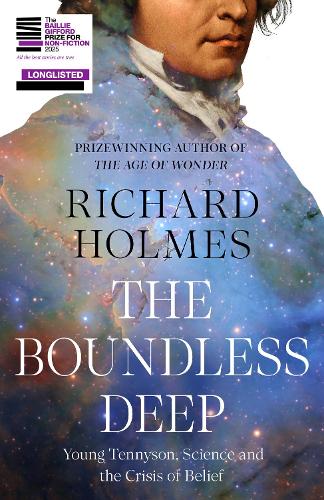
The Boundless Deep :Young Tennyson, Science and the Crisis of Belief
hardback
Published:
25 September, 2025
hardback
Published:
25 September, 2025

FREE Delivery by
Sat, April 18 - Sun, April 19
Order within
0

Condition:
NEW
£18.11
RRP
£25.00
You save £6.89 (28%)
Available
20+
in stock
FREE Returns within 30 days
Popular Books by Richard Holmes
View All Books by Richard Holmes

Description
*SHORTLISTED FOR THE BAILLIE GIFFORD PRIZE*
*SHORTLISTED FOR THE POL ROGER DUFF COOPER PRIZE*
A Book of the Year in the Times; Telegraph; Spectator; Financial Times; Observer; Waterstones and Daunt Books
A dazzling new biography of young Tennyson by the prize-winning, bestselling author of The Age of Wonder.
Alfred Lord Tennyson is now remembered – if he is remembered at all – as the gloomily bearded Poet Laureate, author of such clanking Victorian works as ‘The Charge of the Light Brigade’, and the mournful author of the lugubrious elegy In Memoriam. In this dazzling new biography, Richard Holmes reawakens this somnolent Victorian figure, brings him back to sparkling life, and unexpectedly transforms him.
From the prize-winning and bestselling biographer of Shelley and Coleridge, and author of the landmark, critically acclaimed THE AGE OF WONDER, Holmes recovers in Young Tennyson an astonishingly magnetic and mercurial personality, a secretly expressive and highly emotional man but now haunted by the great intellectual – and above all the great scientific – issues of his time.
The brilliant child of an obscure dysfunctional Lincolnshire family, terrorised by a drunken father, torn by unhappy love affairs but sustained by vivid friendships (especially that of Edward FitzGerald, the author of ‘Omar Khayyam’) Young Tennyson emerges in his first forty years as a memorable poet, hypnotically musical (‘The Lady of Shalott’) yet intensely engaged with the new astronomy, geology, biology – and even the psychiatry – of the age before Darwin.
Tennyson’s imagination and intellect were haunted by the eruption of three new fundamentally transformative scientific ideas – biological evolution, the notion of a godless, unpitying universe and of planetary extinction. These were as terrifying to Tennyson as climate catastrophe is to us today. Their impact brought him into contact with the life and scientific work of William Whewell (originally his university tutor), the astronomer John Herschel, the geologist Charles Lyell, the mathematician Mary Somerville, the computer pioneer Charles Babbage, and the brilliant science populariser Robert Chambers. He also shared his visions and anxieties with contemporary writers and social commentators like Thomas Carlyle and Charles Dickens, and poets like Elizabeth Barrett Browning and Edgar Allan Poe.
Tennyson’s work during these ‘vagrant years’ is suffused with an unsuspected and strangely modern magic. Holmes’s extraordinary biography allows us to witness Tennyson wrestling with mind-altering ideas of geology and deep time, the vastness, beauty and terror of the new cosmology, and the challenges of social revolution. And how these inspired him to grapple with the idea of human mortality, the threat of suicide and depression, the struggle between love and loneliness, agnosticism and belief.
More Details
| Type | Book |
|---|---|
| ISBN13 | 9780007386932 |
| ISBN10 | 0007386931 |
| Number Of Pages | 448 |
| Item Weight | 710 g |
| Product Dimensions | 159 x 240 x 44 mm |
| Publisher / Reseller | HarperCollins Publishers |
| Format | hardback |
See More +
Media Reviews
A Book of the Year in the Times; Telegraph; Spectator; Financial Times; Observer; Waterstones and Daunt Books
‘Replaces the dusty usual portraits of the poet laureate – as the gloomy Victorian author of the GCSE syllabus poem The Charge of the Light Brigade – with a sparkling vision of him as an intelligent and imaginative man who welcomed in the new scientific age. Truly enriching’
SUNDAY TIMES
‘Holmes is probably our greatest chronicler of the Romantic poets … The Boundless Deep is a dazzling and tireless work of advocacy … Feather duster at the ready, Holmes swats the crepe and the cobwebs away to restore the living Tennyson as he was before he fossilised into a Victorian sage’
THE TIMES
‘Compelling … a fascinating insight into a great British poet whose depths, like those of the sea in his poem “Crossing the Bar” (1889), remain boundless themselves’
DAILY TELEGRAPH
‘A spryly written but deeply learned biography’
SPECTATOR
‘Biographer Richard Holmes specialises in seeing familiar figures from a new slant … Takes a dive into the works of Alfred Lord Tennyson, rubbing away the stately, bearded behemoth beloved of Queen Victoria to reveal a more vibrant, youthful character’
FINANCIAL TIMES
‘There is an unusual, gentle mixture of imagination and empiricism in everything Holmes writes: a poetic sense of human psychology combined with a meticulous organised mind’
NEW STATESMEN
'An extraordinary glimpse into the nature of poetic genius and the heart of the Victorian miracle – no-one can match Holmes’ range and sensitivity'
RORY STEWART
‘Richard Holmes, in this new biography, wants to create a fresh portrait of the young Tennyson, before the beard made him a Victorian. He has succeeded triumphantly in doing so…with enormous insight and subtlety’
DAILY MAIL
‘Shakes off the poet’s fusty image to reveal a young man grappling with the doubts of his age… Holmes presents Tennyson as more interesting, more clever, more elusive and downright peculiar than modern readers may imagine'
OBSERVER
Author's Bio
Richard Holmes is the author of The Age of Wonder, which won the Royal Society Prize for Science Books and the National Book Critics Circle Award and was one of the ten New York Times’ Best Books of the Year in 2009. His balloon book, Falling Upwards, was chosen as a Best Book of the Year by seven newspapers in 2013. His other biographies include Shelley: The Pursuit (winner of the 1974 Somerset Maugham Prize), Coleridge: Early Visions (winner of the 1989 Whitbread Book of the Year Award), Coleridge: Darker Reflections (shortlisted for the Samuel Johnson Prize and winner of the Duff Cooper Prize), and Dr. Johnson & Mr. Savage (winner of the 1993 James Tait Black Prize). This Long Pursuit completes the autobiographical trilogy begun in Footsteps (1985) and Sidetracks (2000). Holmes was awarded the OBE in 1992, and was elected an Honorary Fellow of Churchill College, Cambridge, in 2010.